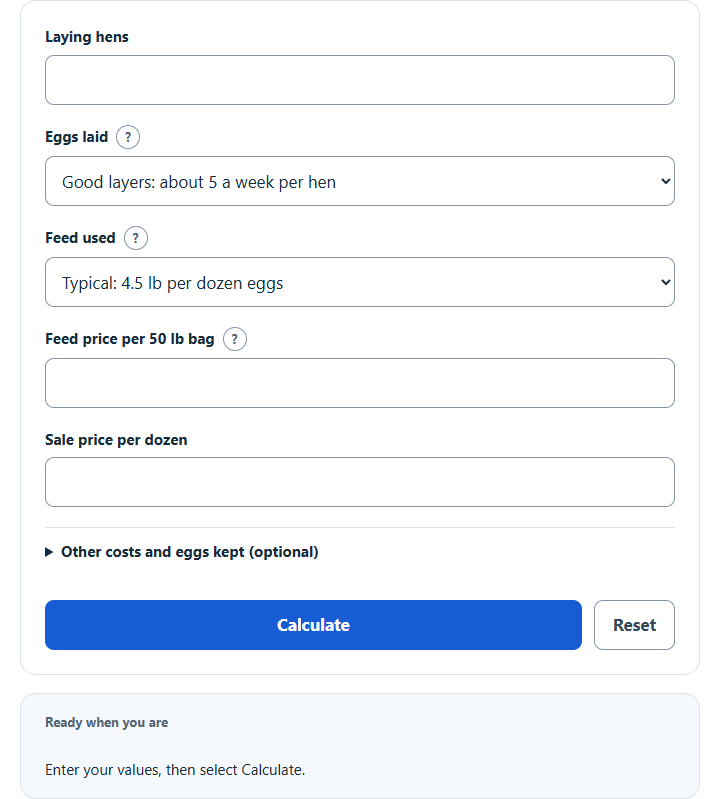
Calculate the profit from selling backyard chicken eggs from your number of hens, feed price and price per dozen, with cost per dozen and break-even price.
- All Biology Calculators
- Cost Per Egg Calculator
- Chicken Feed Amount Calculator
- Chicken Coop Size Calculator
- Chicken Rate Calculator
- Egg Incubation Hatch Date Calculator
Calculator Functions
The calculator estimates the yearly profit from selling the eggs of a backyard or small laying flock. It also shows the profit per month, how many dozen the flock lays, the cost to produce a dozen and the price per dozen at which you break even.
| Function | Use it when | You enter |
|---|---|---|
| Profit from selling eggs | You sell eggs, or are deciding what to charge | Number of laying hens, feed price per 50 lb bag and sale price per dozen |
| Other costs and eggs kept | You have other monthly costs or keep some eggs to eat | Other costs per month and the share of eggs sold, in the optional section |
You do not need to know your flock's laying rate or feed use: the calculator starts from typical figures for good laying hens, about 5 eggs a week per hen and 4.5 lb of feed per dozen eggs [1]. Switch either one to Custom to enter your own. To work out what eggs cost at the store, use the Cost Per Egg Calculator.
Egg Profit Formulas
| D | Dozens of eggs laid per year |
| s | Share of the eggs that are sold, as a fraction |
| P | Sale price per dozen ($) |
| F | Feed cost per year ($) |
| O | Other costs per year ($) |
Eggs laid
H is the number of hens and L is the lay rate, the share of days on which a hen lays. The calculator uses 0.70 for good layers, which is about 5 eggs a week, or your eggs per hen per week divided by 7. Ten hens lay 10 × 365 × 0.70 ÷ 12 = 212.9 dozen a year.
Feed cost
A laying flock uses about 4.5 lb of feed for each dozen eggs [1], and B is the price of a 50 lb bag. For the ten hens, 212.9 × 4.5 = 958 lb of feed, which at $15 a bag costs 958 ÷ 50 × 15 = $287.44. If you enter your own feed per hen per day instead, the feed is H × lb per day × 365.
Cost per dozen and break-even price
E = (F + O) ÷ (D × s)
C is the running cost of each dozen laid and E is the break-even price per dozen. The break-even price spreads the same costs over only the dozens you sell, so it rises when you keep eggs for yourself. With no other costs and every egg sold, the ten hens cost $287.44 ÷ 212.9 = $1.35 a dozen, and selling at $6 a dozen leaves 212.9 × 6 − 287.44 = $990.06 a year.
Limits of This Estimate
- The result covers running costs only. The coop, feeders, chicks and your time are left out. A University of Maryland Extension budget for 10 hens over three years that includes housing, equipment, chicks and electricity, but not labor, comes to $3.37 per dozen, as of August 2026 [1].
- The 70% lay rate is for high-yielding breeds such as Leghorns or Rhode Island Red crosses with extra light in winter, and already allows for some hens dying. Dual-purpose breeds lay fewer eggs, and hens stop laying while they molt [1].
- Feed and egg prices change. The examples here use $15 for a 50 lb bag of layer feed and $6 a dozen, the figures in the same budget as of August 2026 [1]. Enter what you actually pay and charge.
- Selling eggs can be regulated. Check state and local rules on licensing, labeling, packaging and storage before you sell [1].
Sources
- Moyle, Johnson, Tabler and Bruce, Backyard Layer Flock Economics: How Much Does It Cost You to Produce a Dozen Eggs? (FS-2025-0783), University of Maryland Extension, August 2026: the 70% egg yield, 4.5 lb of feed per dozen, the example feed and egg prices, the full-cost budget and the notes on breeds, molting and selling