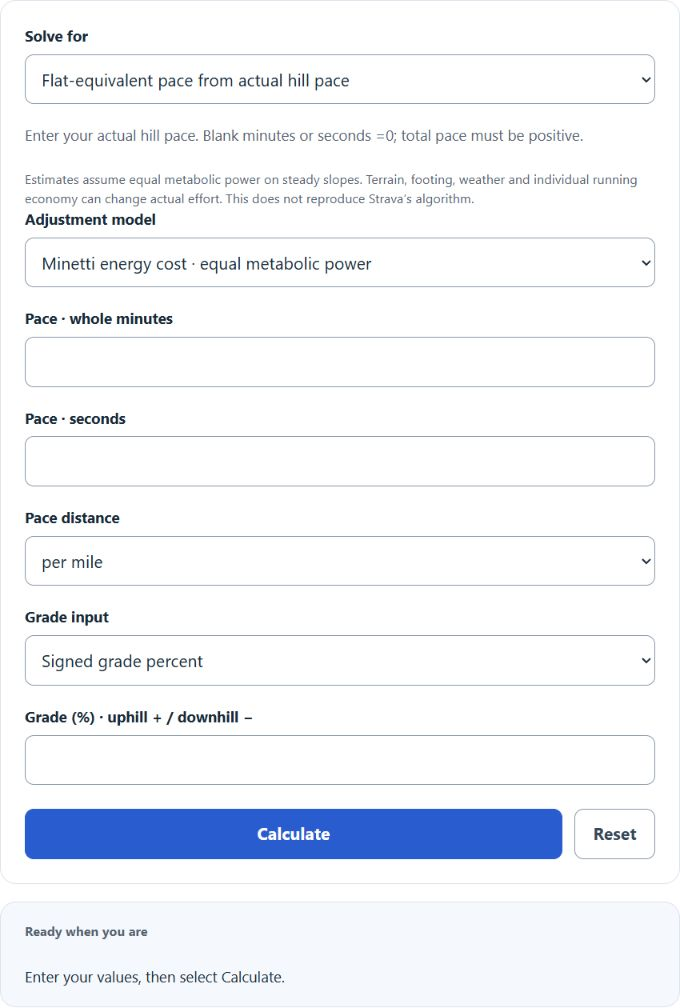
Calculate your grade adjusted pace (GAP) from a running pace and hill grade, or find the pace to run on a hill to hold a target flat effort.
Grade Adjusted Pace Formula
Grade adjusted pace estimates a flat-equivalent running pace from a slope. The default model uses the running energy-cost polynomial in Minetti et al.(2002), Fig.1, with f =C(i)/3.6 and decimal slope i =grade(%)/100. Converting energy cost to pace assumes equal metabolic power; this is a modeling assumption, not a validated outdoor race prediction. GAP =P/f:
GAP = P / f
The calculator can also run this backwards. If you know the flat effort you want to hold, it multiplies that target by the same factor to give the pace to run on the hill:
P_hill = GAP_target * f
The optional original simple curve is retained as an unvalidated illustration. Its coefficients have no documented calibration dataset here and should not be interpreted as measured effort changes. For a positive steepness G in percent, its equations are:
f uphill = 1 + 0.025 G + 0.0006 G^2
 f downhill = 1 - 0.015 G (to 10 percent down)
 f steep down = 0.85 + 0.02 (G - 10)
Variables:
- GAP is the grade adjusted pace, the flat-ground pace that represents the same effort
- P is your actual pace on the slope, in minutes per mile or per kilometer
- GAP_target is the flat effort you want to hold, used in the reverse mode
- P_hill is the pace to run on the slope to hold that target effort
- f is the grade adjustment factor for the slope
- G is signed grade(%):100 × elevation change / horizontal run. If the entered distance follows the slope, the widget first derives horizontal run.
Pick what you want to find at the top of the calculator. In the first mode you enter your actual pace and the grade, and the tool returns your grade adjusted pace along with the adjustment factor and how much harder or easier the slope is than flat. In the reverse mode you enter a target grade adjusted pace and the grade, and the tool returns the pace to run on that slope so the effort matches your flat target. You can type the grade directly, or enter an elevation change and the distance it covers and let the tool work out the grade for you.
Grade Adjustment Factor by Slope
This table compares the optional original simple curve with the Minetti running-cost ratio. The latter measures modeled energy per mass per distance, not energy per stride. These are different models; neither guarantees individual pace or actual percentage effort. Minetti’s treadmill study involved ten elite male mountain runners over−45% to+45% slopes. Read the primary study.
| Grade | Adjustment factor | Original factor change | Minetti cost ratio |
|---|---|---|---|
| 15% downhill | 0.95 | 5.00% lower | 0.51 |
| 10% downhill | 0.85 | 15.00% lower | 0.60 |
| 6% downhill | 0.91 | 9.00% lower | 0.72 |
| 3% downhill | 0.96 | 4.50% lower | 0.85 |
| Flat (0%) | 1.00 | same | 1.00 |
| 3% uphill | 1.08 | 8.04% higher | 1.17 |
| 6% uphill | 1.17 | 17.16% higher | 1.37 |
| 10% uphill | 1.31 | 31.00% higher | 1.66 |
| 15% uphill | 1.51 | 51.00% higher | 2.06 |
The second table is an illustration of the original simple curve for a 9:00/mi flat target. Select “Original simple curve” in the widget to reproduce it. It is not a recommended pacing plan; outdoor downhill performance can be constrained by footing, braking and technical terrain.
| Grade | Pace to run (9:00/mi flat target) | vs flat |
|---|---|---|
| 10% downhill | 7:39/mi | 1:21 faster |
| 6% downhill | 8:11/mi | 0:49 faster |
| 3% downhill | 8:36/mi | 0:24 faster |
| Flat (0%) | 9:00/mi | even |
| 3% uphill | 9:43/mi | 0:43 slower |
| 6% uphill | 10:33/mi | 1:33 slower |
| 10% uphill | 11:47/mi | 2:47 slower |
Example Problems
Example 1: find grade adjusted pace from your run.
Original-curve example1: 9:00/mi on a+6% slope uses f =1+0.025(6)+0.0006(6²) =1.1716. The illustrative GAP is540/1.1716 =460.908 seconds, or7:41/mi. The default Minetti model gives a different estimate.
Example 2: find the pace to hold a target effort uphill.
Original-curve example2: an8:00/mi target at+8% uses f =1+0.025(8)+0.0006(8²) =1.2384. The illustrative hill pace is480 ×1.2384 =594.432 seconds, or9:54/mi.
Frequently Asked Questions
Why is my grade adjusted pace faster than my actual pace uphill?
In an energy-cost model, uphill running costs more energy per traveled distance, so a fixed hill pace corresponds to a faster estimated flat pace under equal metabolic power. Downhill cost and achievable speed depend on slope and running mechanics; no universal15% effort credit is established by this tool.
Does this match Strava’s grade adjusted pace?
No numerical match or closeness to Strava is established. Strava’s official engineering explanation describes replacing its Minetti-based model with an equivalent-heart-rate model derived from real-world runs. This calculator offers a transparent laboratory energy-cost approximation and an unvalidated original curve. Strava’s model explanation.
Why does steep downhill running stop getting easier?
Downhill running involves braking and coordination constraints. The minimum of the Minetti energy-cost curve and the turning point imposed by the original simple curve are different. Neither establishes a safe or achievable downhill running speed, especially on steep or technical terrain.