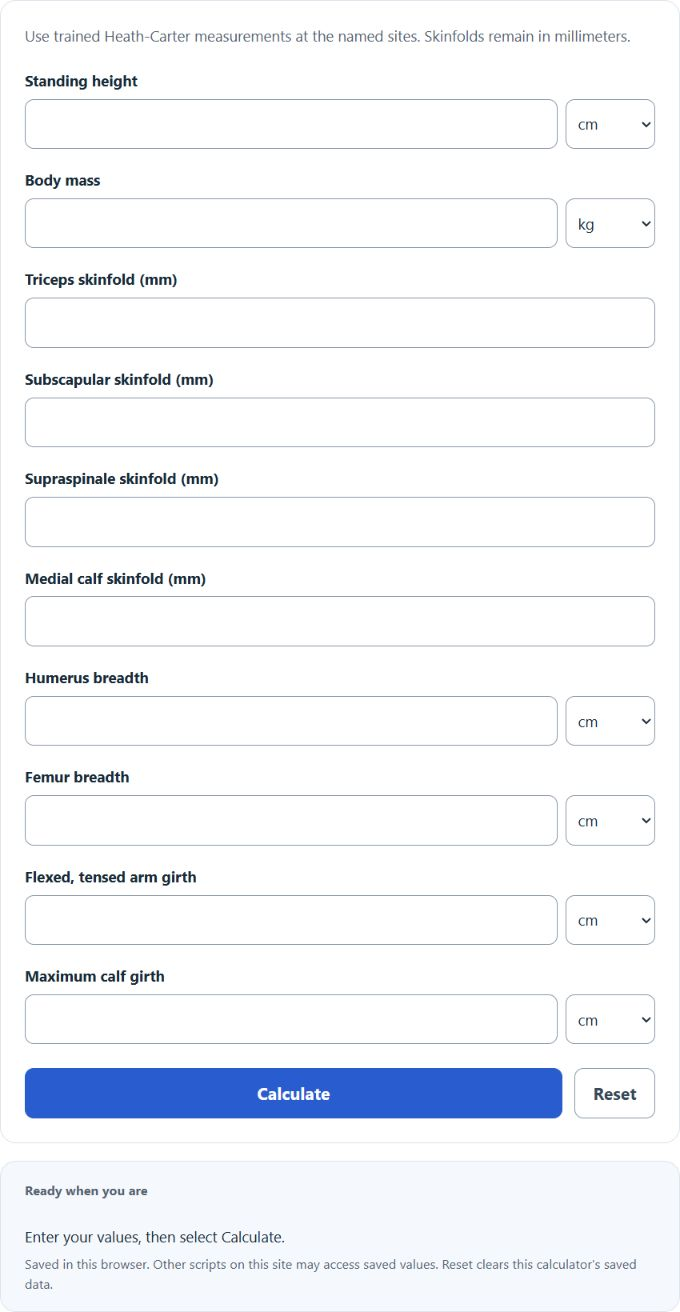
Calculate the three-number Heath-Carter anthropometric somatotype from measured skinfolds, bone breadths, limb girths, height, and weight.
How the Heath-Carter Somatotype Calculation Works
The Heath-Carter anthropometric method reports three components in a fixed order: endomorphy, mesomorphy, and ectomorphy. Endomorphy is calculated from a height-corrected sum of the triceps, subscapular, and supraspinale skinfolds. Mesomorphy combines humerus and femur breadths with flexed arm and maximum calf girths corrected by the corresponding skinfolds, then adjusts for height. Ectomorphy is calculated from height divided by the cube root of body mass, using one of three published branches.
The score is a three-number coordinate, not three percentages. A result such as 3.1 – 4.4 – 2.7 means the measured mesomorphy component is largest in that assessment; it does not mean that 44 percent of the body is mesomorphic. Somatochart coordinates can be derived as x = ectomorphy – endomorphy and y = 2 x mesomorphy – endomorphy – ectomorphy.
Measurements and Their Roles
| Input | Required technique or unit | Role in the calculation |
|---|---|---|
| Height and weight | Standing height and body mass; converted to centimeters and kilograms | Height correction, mesomorphy adjustment, and height-weight ratio |
| Triceps, subscapular, supraspinale | Skinfold thickness in millimeters at the named anatomical sites | Height-corrected sum used for endomorphy |
| Humerus and femur breadth | Biepicondylar breadth in centimeters or inches | Bone-breadth terms in mesomorphy |
| Flexed arm girth | Flexed, tensed upper-arm circumference | Corrected by subtracting triceps skinfold divided by 10 |
| Maximum calf girth | Maximum calf circumference | Corrected by subtracting medial calf skinfold divided by 10 |
| Medial calf skinfold | Skinfold thickness in millimeters | Correction applied to maximum calf girth |
The Three Equations
Let X be the sum of triceps, subscapular, and supraspinale skinfolds multiplied by 170.18 divided by height in centimeters. Endomorphy is -0.7182 + 0.1451X – 0.00068X squared + 0.0000014X cubed.
Corrected arm girth equals flexed arm girth in centimeters minus triceps skinfold in millimeters divided by 10. Corrected calf girth is calculated the same way using maximum calf girth and medial calf skinfold. Mesomorphy is 0.858 x humerus breadth + 0.601 x femur breadth + 0.188 x corrected arm girth + 0.161 x corrected calf girth – 0.131 x height + 4.5.
Let HWR equal height in centimeters divided by the cube root of weight in kilograms. If HWR is at least 40.75, ectomorphy is 0.732 x HWR – 28.58. If HWR is greater than 38.25 but less than 40.75, it is 0.463 x HWR – 17.63. At 38.25 or below, ectomorphy is 0.1.
Under the manual’s convention, any calculated component at or below zero is assigned 0.1; recheck the measurements when this occurs. The largest-component summary is descriptive and is not the formal 13-category classification. This tool retains the original supported ranges: height 100–250 cm, mass 20–350 kg, skinfolds 1–100 mm, breadths 2–20 cm, and girths 10–100 cm. These are application limits, not universal Heath-Carter method limits.
Worked Example
For an illustrative set of measurements—180 cm, 75 kg, skinfolds of 10 mm at the triceps, 12 mm at the subscapular site, 10 mm at the supraspinale site, and 10 mm at the medial calf, with 7.0 cm humerus breadth, 9.5 cm femur breadth, 33 cm flexed arm girth, and 37 cm calf girth—the height-corrected three-skinfold sum is about 30.25. Corrected arm and calf girths are 32 cm and 36 cm. The resulting score is approximately 3.1 – 4.4 – 2.7. These entries demonstrate the arithmetic and are not reference, target, or ideal values.
Use and Safety Limits
Accuracy depends heavily on landmarking, caliper pressure, repeated skinfold technique, bone-breadth technique, and consistent girth tension. Small site or technique differences can change the score. For comparison over time, use a trained anthropometrist, the same protocol and equipment, and similar measurement conditions.
This result is descriptive, not diagnostic. It is not a body-fat percentage, a muscle-mass measurement, a personality category, a metabolism test, or a prediction of health, performance, or sport suitability. It should not be used to prescribe weight loss, set an ideal body target, or judge appearance. If physique tracking worsens body-image or eating concerns, consider stopping and discussing those concerns with an appropriately qualified health professional.
Sources
Carter, J. E. L., and Heath, B. H. Somatotyping: Development and Applications. Cambridge University Press, 1990.
Carter, J. E. L. The Heath-Carter Anthropometric Somatotype: Instruction Manual. Revised 2002.
Kim, J. W., and colleagues. Somatotype Analysis of Elite Boxing Athletes Compared with Nonathletes for Sports Physiotherapy. Journal of Physical Therapy Science, 2014.
Mathisen, T. F., and colleagues. Best Practice Recommendations for Body Composition Considerations in Sport to Reduce Health and Performance Risks. British Journal of Sports Medicine, 2023.