Calculate failure rate, MTBF, and FIT from failures and total operating time, or convert directly between MTBF and failure rate.
- All Statistics Calculators
- Sigma Level Calculator
- DPMO Calculator (Defects Per Million Opportunities)
- Rate Per 1000 Calculator
- System Reliability Calculator
- Defect Density Calculator
Failure Rate Formula
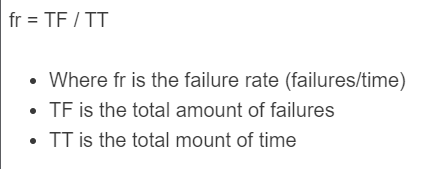
The basic failure rate formula is:
- λ = failure rate
- F = number of failures
- T = total operating time
Under a constant-rate model, failure rate times operating exposure gives the expected number of failures:
Under a constant-rate model, the exposure associated with an expected failure count is shown below. This is not a guaranteed time to failure:
For a compatible constant-rate model, the reciprocal relationship is:
For a fleet or group of assets, total operating time can be found from:
- A = number of assets
- t = operating time per asset
- T = combined operating time for all assets
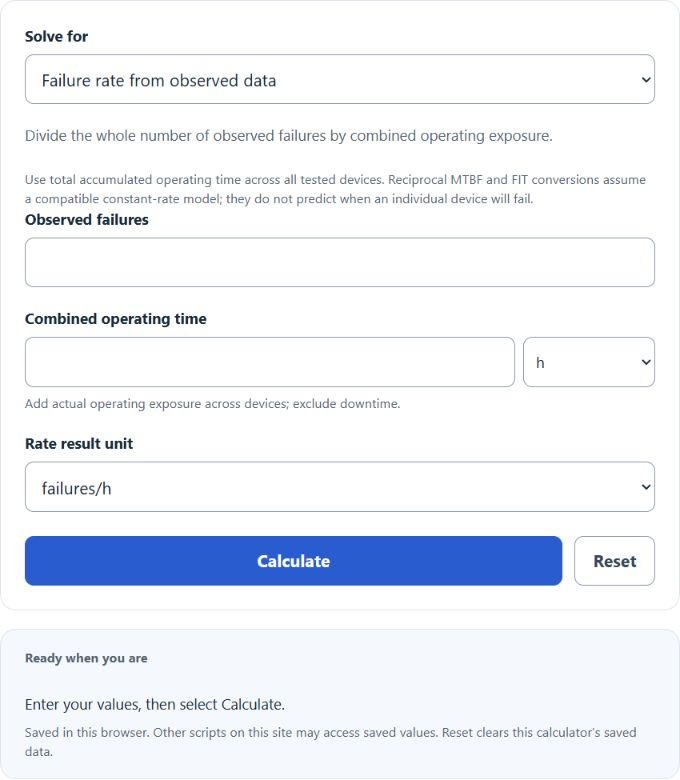
Choose failure rate from observed data, failure rate from MTBF, or MTBF from failure rate. Enter the fields shown; no blank-field solving or separate fleet tab is used. For a fleet, add actual device operating times before entering combined exposure. The rearranged formulas above may be used separately to calculate expected counts or required exposure.
Time Unit Conversions Used
The calculator converts time to hours first. Day and week are fixed operating durations; month means 730 hours and year means 365 days. A FIT is one failure per billion device-hours.
| Unit | Hours Used | Example Rate Meaning |
|---|---|---|
| Hour | 1 | Failures per operating hour |
| Day | 24 | Failures per 24 operating hours |
| Week | 168 | Failures per 168 operating hours |
| Month | 730 | Failures per average month |
| Year | 8,760 | Failures per 365-day year |
Common Failure Rate Interpretations
| Result | Equivalent MTBF | Plain Meaning |
|---|---|---|
| 0.1 failures/hour | 10 hours | About 1 failure every 10 operating hours |
| 0.01 failures/hour | 100 hours | About 1 failure every 100 operating hours |
| 0.001 failures/hour | 1,000 hours | About 1 failure every 1,000 operating hours |
| 0 failures/hour | No finite estimate from zero observed failures | No failures were observed during the measured time |
Example Problems
Example 1: Calculate failure rate from failures and time
You observed 6 failures over 2,000 operating hours.
The failure rate is 0.003 failures/hour. The MTBF is:
Example 2: Calculate fleet failure rate
A fleet has 25 assets. Each asset ran for 400 hours. There were 10 failures.
The fleet failure rate is 0.001 failures/hour. The MTBF is 1,000 hours.
FAQs
What is a failure rate?
Failure rate is the number of failures divided by the amount of operating time. A lower failure rate means failures happen less often. For example, 0.002 failures/hour means an average of 1 failure every 500 operating hours.
How is failure rate different from MTBF?
Failure rate measures failures per unit of operating exposure. Under a compatible constant-rate model, MTBF is its reciprocal: 0.005 failures/hour corresponds to 200 hours. MTBF is not a guaranteed lifetime. Zero observed failures over finite exposure does not establish infinite MTBF.
What counts as total operating time for multiple assets?
Use combined operating time. If 10 assets each run for 100 hours, the total operating time is 1,000 asset-hours. Do not use calendar time unless every asset was operating for that full period.