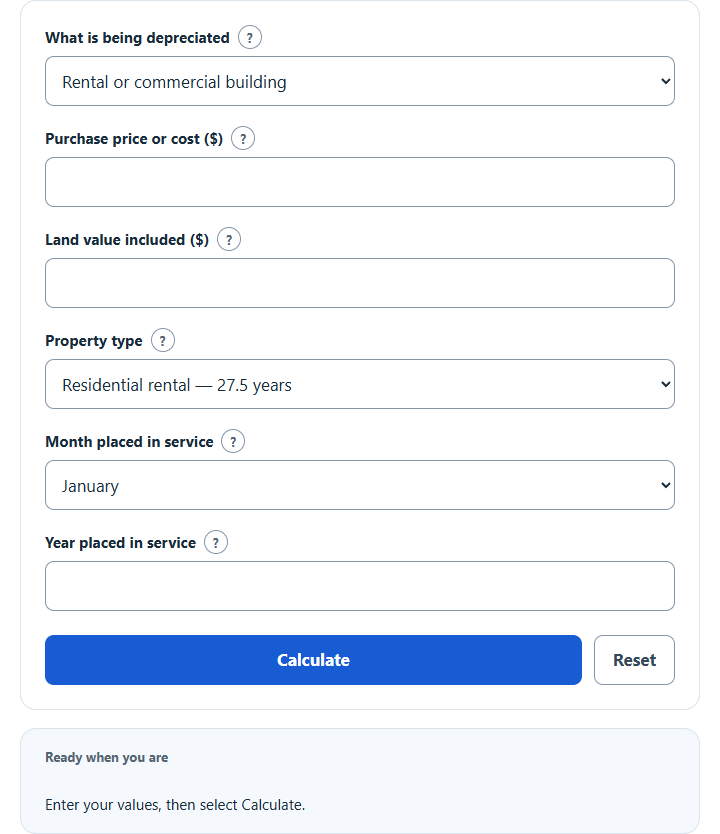
Calculate tax depreciation on a rental or commercial property from its cost, land value and the month it went into service, with a year-by-year schedule.
- All Business Finance Calculators
- Depreciation Calculator (% per year)
- Bonus Depreciation Calculator
- Recapture Depreciation Calculator
- 1031 Exchange Calculator
- Units of Production Depreciation Calculator
Calculator Functions
The calculator gives the U.S. federal tax depreciation deduction for each year an asset is owned, under the MACRS rules for 2025 returns, with a schedule showing the running total and the basis left. Select a function to open it in the calculator.
| Function | Use it when | You enter |
|---|---|---|
| Rental or commercial building | You own a rental house, apartment building, office, store or warehouse | Cost, land value, property type and the month it was placed in service |
| Equipment and other assets | The asset is a vehicle, computer, appliance, furniture or a land improvement | Depreciable basis and property class |
Both functions accept an optional year placed in service, which labels the schedule with calendar years. For book depreciation at a chosen percentage or useful life, use the Depreciation Calculator (% per year).
Property Depreciation Formulas
D1 = D × (12.5 − m) ÷ 12
| D | Deduction for a full year ($) |
| D1 | Deduction for the first year ($) |
| B | Depreciable basis: cost minus land ($) |
| N | Recovery period: 27.5 years for residential rental property, 39 years for nonresidential property [1] |
| m | Month placed in service, as a number (January = 1, December = 12) |
Rental or commercial building
Buildings use the straight line method with the mid-month convention: the building counts as placed in service in the middle of its first month, so the first year gets the full months after that month plus half a month [1]. A rental house placed in service in March gets 9.5 months. Every later year gets D, and the last year gets whatever basis is left. Land is never depreciated, so its value comes out of the cost first [2].
Equipment and other assets
P is 2 for the 200% declining balance method and 1.5 for the 150% method, N is the property class in years, and Bk is the basis left at the start of year k. Y is the number of years left in the recovery period at the start of the year, N − k + 1.5. The half-year convention gives half a year of depreciation in the first year and the rest in year N + 1. The method changes to straight line in the first year that it gives an equal or larger deduction [1].
| Class | Examples | Method | Rate r | Straight line from |
|---|---|---|---|---|
| 3-year | Tractor units, racehorses over 2 years old | 200% | 66.667% | Year 3 |
| 5-year | Cars, trucks, office machinery, appliances and furniture in a rental | 200% | 40% | Year 4 |
| 7-year | Office furniture and fixtures | 200% | 28.571% | Year 5 |
| 10-year | Boats and barges, fruit or nut trees | 200% | 20% | Year 7 |
| 15-year | Fences, roads, sidewalks, shrubbery | 150% | 10% | Year 7 |
| 20-year | Farm buildings | 150% | 7.5% | Year 9 |
Limits of This Estimate
- These are U.S. federal rules under the General Depreciation System, as published for 2025 returns, for a calendar tax year [1]. Other countries use different systems, such as capital allowances in the UK, and U.S. states can differ from the federal rules.
- The deduction is figured from the method itself. The IRS percentage tables round their rates, so a return prepared from the tables can differ slightly, and once the tables are used for an asset they generally must be used for its whole recovery period [1].
- Equipment and other assets always uses the half-year convention. The mid-quarter convention applies instead when more than 40% of the year’s new property was placed in service in the last three months [1].
- Section 179 deductions and bonus depreciation are not figured here. Both reduce the basis before regular depreciation starts [1], so subtract them first. The sale year and the alternative system (ADS) are also left out.
- The split between land and building is yours to supply. One accepted way is to divide the cost in proportion to the assessed values on the property tax bill [2].
Sources
- Internal Revenue Service, Publication 946 (2025), How To Depreciate Property, Chapter 4: recovery periods, property classes, methods, conventions and figuring the deduction without the tables
- Internal Revenue Service, Publication 527 (2025), Residential Rental Property, Chapter 2: land, dividing cost between land and building, and residential rental depreciation