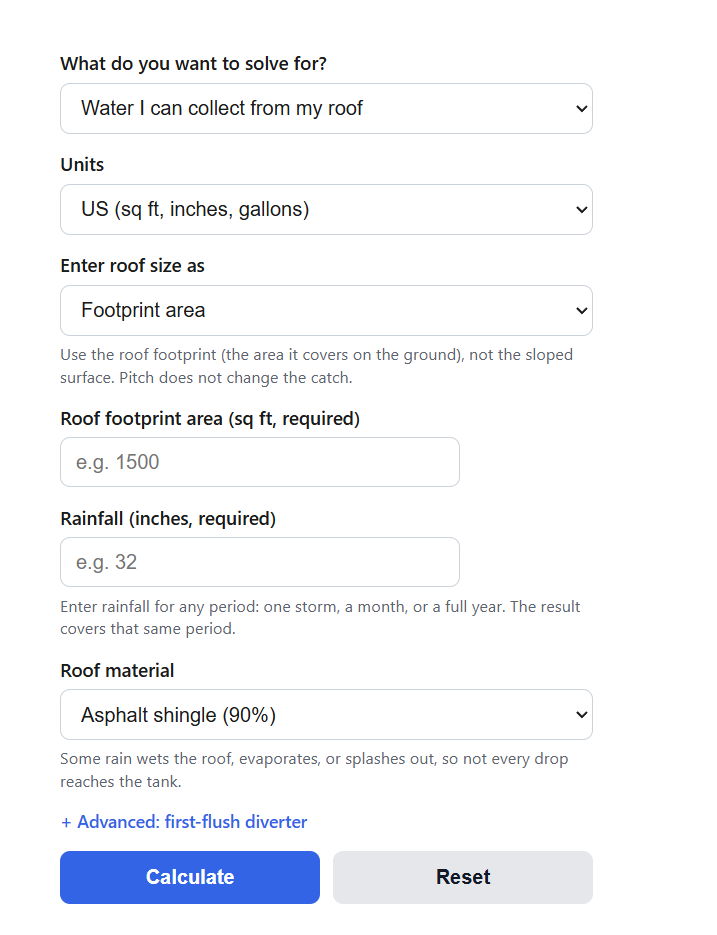
Calculate how many gallons of rainwater you can collect from your roof, plus the roof area or tank size you need to cover dry spells.
Rainwater Harvesting Formula
The calculator's main mode estimates the volume of water you can collect from a roof:
V = A * R * 0.623 * C
In metric units the conversion factor drops out, because 1 mm of rain on 1 square meter is exactly 1 liter:
V = A * R * C
Variables:
- V is the volume of water collected (gallons in US units, liters in metric)
- A is the roof footprint area (sq ft or m²), meaning the area the roof covers on the ground, not the sloped surface
- R is the rainfall depth over the period (inches or mm)
- 0.623 is the number of gallons in one inch of rain over one square foot
- C is the runoff coefficient, the fraction of rain that actually reaches the tank after evaporation, splash, and absorption losses (typically 0.8 to 0.95)
The second mode rearranges the same equation to solve for the roof area needed to hit a target volume, A = V / (R * 0.623 * C). The third mode handles storage: it sizes a tank as T = D * d, where D is daily water use and d is the number of dry days to cover, or divides tank volume by daily use to give days of supply. The advanced option also estimates the first-flush diversion, the initial dirty runoff a diverter discards each rain event, at a default of 1 gallon per 100 sq ft of roof.
Runoff Coefficients and Yield by Rainfall
The runoff coefficient depends mostly on roofing material. Smooth, sealed surfaces deliver more of each storm to the tank, and they also matter if you plan to filter the water for drinking.
| Roof material | Runoff coefficient | Notes for collection |
|---|---|---|
| Metal (standing seam, corrugated) | 0.90 - 0.95 | Best all-around choice; smooth and the preferred surface for potable systems |
| Asphalt shingle | 0.85 - 0.90 | Fine for irrigation; granules and leachate make it a poor choice for drinking water |
| Clay or concrete tile | 0.85 - 0.90 | Unsealed tile absorbs some rain in light storms; sealed tile performs like metal |
| Flat built-up or gravel | 0.70 - 0.80 | Ponding and slow drainage lose more water between storms |
| Green (vegetated) roof | 0.30 - 0.50 | Designed to retain rain; usually not worth plumbing to a tank |
This second table shows the annual yield from 1,000 sq ft of roof at a 0.9 coefficient, which is a quick way to sanity-check a result or scale one to your own roof.
| Annual rainfall | Yield per 1,000 sq ft | 55-gallon barrels |
|---|---|---|
| 10 in (Phoenix, Las Vegas) | 5,607 gal | 102 |
| 20 in (Denver, Los Angeles) | 11,214 gal | 204 |
| 30 in (Minneapolis, Dallas) | 16,821 gal | 306 |
| 40 in (Chicago, Seattle, New York) | 22,428 gal | 408 |
| 50 in (Houston, Atlanta, Miami) | 28,035 gal | 510 |
Example Problems
Example 1: How much water can a house collect in a year?
Your roof footprint is 1,500 sq ft, your area gets 32 inches of rain per year, and the roof is asphalt shingle (C = 0.9):
V = 1,500 * 32 * 0.623 * 0.9 = 26,914 gallons per year. A first-flush diverter on this roof would discard about 15 gallons per rain event (1,500 / 100 * 1).
Example 2: What tank size covers a summer dry spell?
You irrigate with 60 gallons per day and want to ride out 21 dry days:
T = 60 * 21 = 1,260 gallons. Rounding up, a 1,500-gallon tank covers the dry spell and leaves headroom to capture large storms without overflowing.
Frequently Asked Questions
Does roof pitch change how much rainwater I can collect?
No. Rain falls on the footprint of the roof, the flat area it covers on the ground, so a steep roof and a flat roof with the same footprint catch the same water. Measure length times width of the building including overhangs. Pitch only affects how fast water moves to the gutters, which matters for gutter sizing, not for total volume.
Why is my real yield lower than the formula predicts?
Three losses stack up. The runoff coefficient covers roof-level losses (evaporation, splash, absorption). First-flush diverters then discard the initial dirty runoff each storm, roughly 1 to 2 gallons per 100 sq ft per event, which adds up in climates with many small storms. Finally, a full tank overflows, so any rain that arrives when storage is full is lost. Sizing the tank against your longest typical dry spell, not just annual rainfall, keeps overflow losses down.
Is it legal to harvest rainwater?
In most of the United States, yes, and several states actively encourage it with rebates or tax incentives. A few western states regulate it: Colorado limits most homeowners to two barrels totaling 110 gallons, and Utah requires registration above certain volumes. Check your state and local rules before installing a large cistern, especially for indoor or potable use, which usually has its own plumbing code requirements.