Calculate pixel density, physical width, or pixel count from any two values using px, µm, mm, cm, m, and ppi, px/cm, px/mm, or px/µm units.
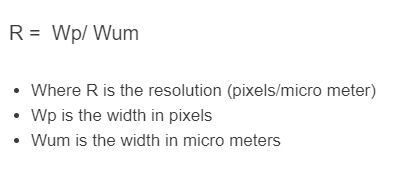
Resolution (Pixel Density) Formula
The calculator uses pixel count, physical width, and pixel density. Select the quantity to solve, then enter the two known values.
- PD = pixel density, such as px/in, px/cm, px/mm, or px/µm
- P = width in pixels
- W = physical width, in the length unit that matches the pixel density unit
For calculations, the tool converts physical width to micrometers and converts pixel density to pixels per micrometer when needed.
- Calculate pixel density: use pixel width divided by physical width.
- Calculate width in pixels: use pixel density multiplied by physical width.
- Calculate physical width: use pixel width divided by pixel density.
Pixel Density Unit Conversions
Use these conversions to understand how the same density changes between units.
| Unit | Meaning | Conversion to px/µm |
|---|---|---|
| ppi | pixels per inch | ppi ÷ 25,400 |
| px/cm | pixels per centimeter | px/cm ÷ 10,000 |
| px/mm | pixels per millimeter | px/mm ÷ 1,000 |
| px/µm | pixels per micrometer | no conversion needed |
Common Pixel Density Reference Values
| Use case | Typical pixel density | Notes |
|---|---|---|
| Basic screen display | 72 to 110 ppi | Common for older or standard desktop displays. |
| High-density phone display | 300 to 500+ ppi | Small physical size with many pixels. |
| Print at good quality | 300 ppi | Often used as a target for sharp printed images. |
| Microscopy or sensor measurements | px/µm or px/mm | Usually based on a calibrated physical field of view. |
Example Calculations
Example 1: Calculate pixel density in ppi
You have an image that is 1920 pixels wide and displays across 10 inches.
The pixel density is 192 ppi.
Example 2: Calculate physical width
You have a 3000-pixel-wide image at 300 ppi.
The physical width is 10 inches.
FAQ
What is pixel density?
Pixel density is the number of pixels packed into one unit of physical length. A value of 300 ppi means there are 300 pixels in each inch. Higher pixel density means more pixels fit into the same physical space.
Is ppi the same as resolution?
Not exactly. Resolution often means the total pixel dimensions, such as 1920 × 1080 pixels. Pixel density means how tightly those pixels are packed into a physical size, such as 192 ppi. You need both pixel count and physical size to calculate pixel density.
Why does physical width matter?
The same pixel width can have different pixel densities depending on physical size. For example, 1000 pixels across 10 inches is 100 ppi. The same 1000 pixels across 5 inches is 200 ppi.