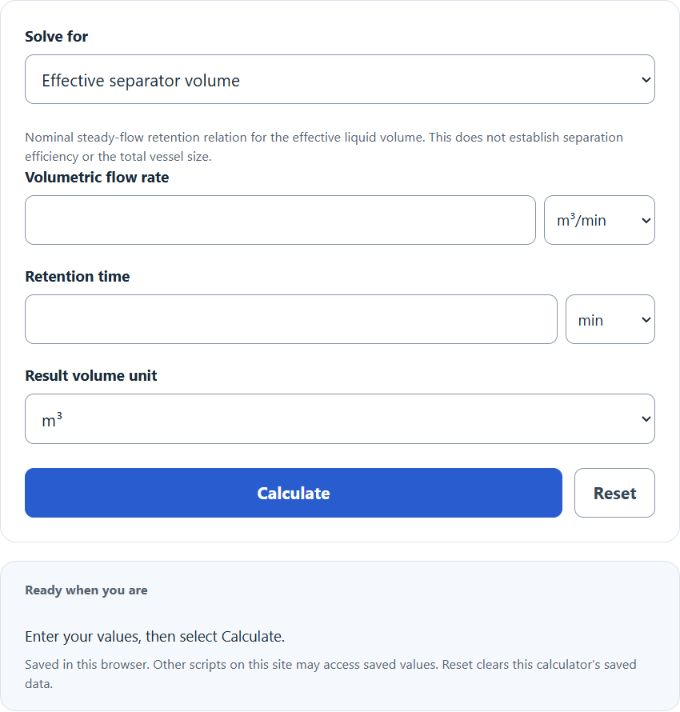
Calculate separator volume, flow rate, or retention time by entering any two values in the volume = flow rate × time relationship.
Related Calculators
- Vessel Volume Calculator
- Liquid Volume Calculator
- Detention Time Calculator
- Flow Time Calculator
- Slurry Flow Rate Calculator
- Rotary Airlock Valve Capacity Calculator
- All Construction Calculators
Separator Volume Formula
The following equation is used to calculate the Separator Volume.
- Where SV is the separator volume (e.g., cubic meters)
- FR is the flow rate (e.g., cubic meters per minute)
- RT is the retention time (e.g., minutes)
To calculate the separator volume, multiply the flow rate by the retention time.
What is a Separator Volume?
Definition:
Here, separator volume means the effective liquid volume in the nominal steady-flow relation V = Q × t. Total vessel capacity and actual separation performance also depend on geometry, internals, phase behavior, freeboard and operating conditions.
How to Calculate Separator Volume?
Example Problem:
The following example outlines the steps and information needed to calculate the Separator Volume.
First, determine the flow rate. In this example, the flow rate is 5 cubic meters per minute.
Next, determine the retention time. In this example, the retention time is 10 minutes.
Finally, calculate the separator volume using the formula above:
SV = FR * RT
SV = 5 * 10
SV = 50 cubic meters
FAQ
What factors can affect the required separator volume?
The required separator volume may be influenced by variations in flow rate, changes in retention time, and the overall efficiency of the separation process. Operational conditions and fluid properties can also play a significant role.
How can you adjust the separator volume for different operational needs?
You can adjust the separator volume by modifying the retention time or controlling the flow rate. Fine-tuning these parameters helps accommodate varying processing conditions and improves separation performance.
Why is calculating the separator volume important in process design?
The retention-volume calculation supports process sizing, but does not by itself ensure phase separation, overflow protection or safe operation. A complete design must assess the relevant flow conditions and separation criteria.