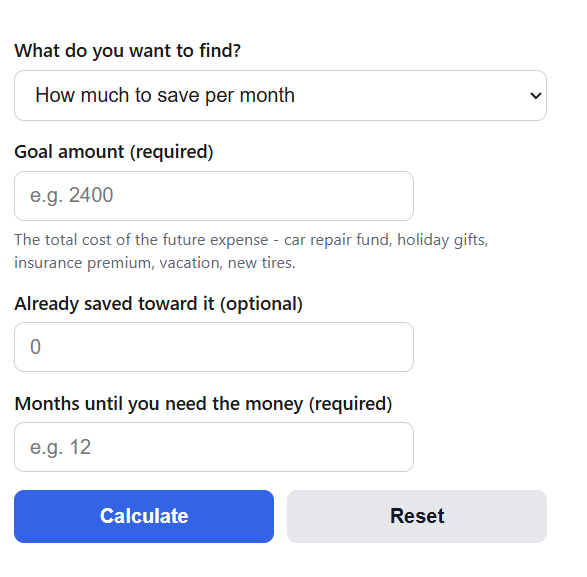
Split any future expense into a monthly savings amount, see how long your goal will take, or project your balance by the deadline.
Sinking Fund Formula
A sinking fund spreads a known future expense over the months you have until the bill arrives:
C = (G - S) / M
The calculator also rearranges the same relationship to solve for time or the final balance:
M = (G - S) / C
  F = S + C * M
Variables:
- C is the monthly contribution
- G is the goal amount – the full cost of the future expense
- S is what you have already saved toward it
- M is the number of months (rounded up when solving for time)
- F is the projected final balance
Pick what you want to find at the top. “How much to save per month” takes the goal and deadline and returns the monthly, weekly, and per-paycheck contribution. “How long until I reach my goal” takes your contribution and returns the timeline, with faster scenarios at 1.5x and 2x the contribution. “What I will have saved” projects the balance at the deadline and compares it to the goal if you provide one.
Common Sinking Fund Categories
These are the irregular expenses that most often break monthly budgets, with typical annual amounts and what they cost per month when spread out.
| Sinking fund | Typical annual cost | Monthly set-aside |
|---|---|---|
| Car repairs & maintenance | $1,200 | $100 |
| Holiday gifts | $900 | $75 |
| Annual insurance premium | $1,800 | $150 |
| Vacation | $3,000 | $250 |
| Home maintenance | $2,400 | $200 |
| New tires | $800 every 4 years | $17 |
Example Problems
Example 1: Saving for holiday gifts.
You want $2,400 for the holidays, have $400 saved, and have 10 months to go:
C = (2,400 – 400) / 10 = $200 per month, which is about $46 per week or $92 per biweekly paycheck.
Example 2: How long to reach a vacation goal.
You need $3,000, have nothing saved, and can put away $250 per month:
M = 3,000 / 250 = 12 months. At $500 per month the timeline halves to 6 months.
Frequently Asked Questions
What is the difference between a sinking fund and an emergency fund?
A sinking fund is for expenses you can see coming – you know roughly when and how much. An emergency fund is for the ones you cannot: job loss, medical bills, the transmission that fails a decade early. Keeping them separate stops planned expenses from draining your true safety net.
Where should I keep sinking funds?
A high-yield savings account works well, and many banks let you split one account into named buckets (car, gifts, vacation) so each fund stays visible. For goals under a year, skip investing the money – the date is too close to ride out a market dip.
Should the calculation include interest?
For typical sinking fund horizons of 3-24 months, interest adds little – about 4% APY on a $200-per-month fund earns roughly $50 over a year. The calculator ignores it, which builds in a small safety margin. For multi-year goals where growth matters, use a compound-interest savings approach instead.