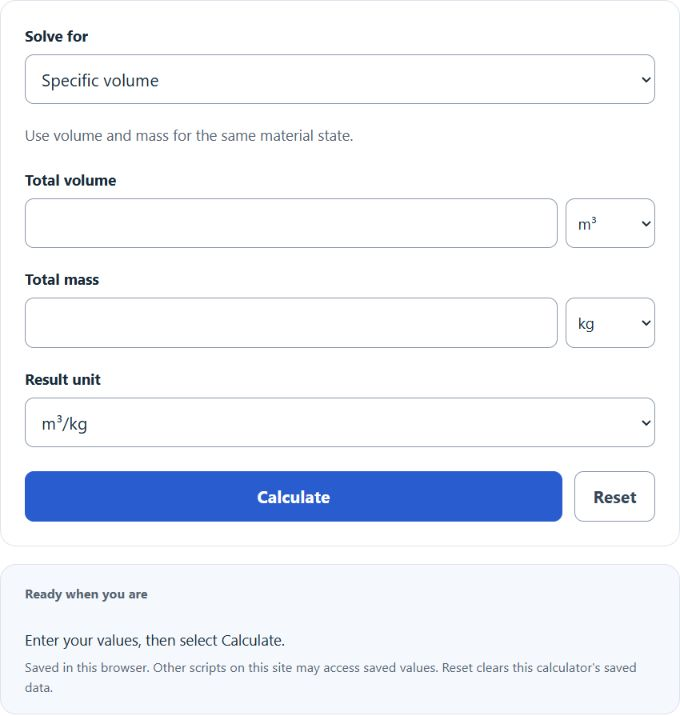
Select specific volume, mass or volume, then enter the two displayed known values. Units include m³, liters, US liquid gallons, cubic feet, pounds and ounces.
- All Physics Calculators
- All Volume Calculators
- Specific Gravity Calculator
- Theoretical Density Calculator
- Mass to Volume Calculator
- Density to Volume Calculator
- Specific Gravity to Density Calculator
- Relative Density Calculator
Specific Volume Formula
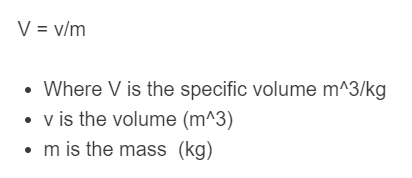
The main relationship is specific volume equals total volume divided by mass.
- v = specific volume
- V = volume
- m = mass
The same relationship can be rearranged depending on which value you need to find.
- V = volume
- v = specific volume
- m = mass
- m = mass
- V = volume
- v = specific volume
If you enter volume and mass, the calculator finds specific volume. If you enter mass and specific volume, it finds volume. If you enter volume and specific volume, it finds mass. Internally, values are converted to base units of cubic meters, kilograms, and cubic meters per kilogram before the result is converted back to your selected unit.
Specific Volume Unit Conversions
These conversions are useful when checking a result by hand.
| Quantity | Unit | Equivalent in base unit |
|---|---|---|
| Volume | 1 liter | 0.001 m³ |
| Volume | 1 US gallon | 0.003785411784 m³ |
| Volume | 1 ft³ | 0.028316846592 m³ |
| Mass | 1 g | 0.001 kg |
| Mass | 1 lb | 0.45359237 kg |
| Mass | 1 oz | 0.028349523125 kg |
Common Specific Volume Reference Values
| Substance or condition | Approximate specific volume | Notes |
|---|---|---|
| Water near room temperature | 0.001 m³/kg | Liquid water is dense, so its specific volume is small. |
| Air near room temperature and 1 atm | about 0.83 m³/kg | Gas values depend strongly on temperature and pressure. |
| Steam at low pressure | varies widely | Use steam tables when pressure and temperature matter. |
Specific Volume Examples
Example 1: Find specific volume
You have a volume of 2 m³ and a mass of 5 kg.
The specific volume is 0.4 m³/kg.
Example 2: Find mass
You have a volume of 10 liters and a specific volume of 2 liters/kg.
The mass is 5 kg.
Specific Volume FAQ
What is specific volume?
Specific volume is the volume occupied by one unit of mass. In SI units, it is usually written as cubic meters per kilogram, or m³/kg. A larger specific volume means the material takes up more space for the same mass.
Is specific volume the same as density?
No. Specific volume is the reciprocal of density. Density is mass divided by volume, while specific volume is volume divided by mass.
For example, if density is 1000 kg/m³, the specific volume is 0.001 m³/kg.
Why does specific volume change for gases?
For gases, specific volume changes when temperature or pressure changes. Increasing temperature usually increases specific volume, while increasing pressure usually decreases it. Liquids and solids often change much less under normal conditions.