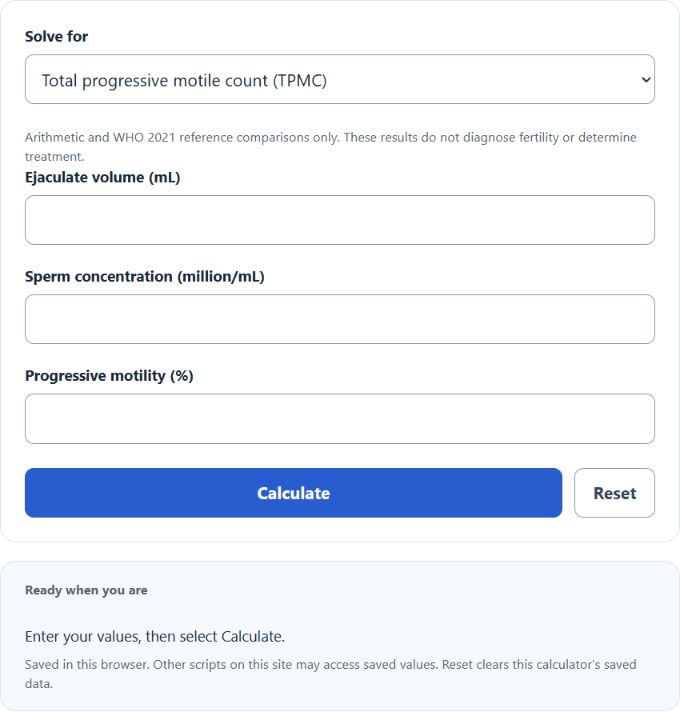
Calculate total progressive motile count (TPMC) from semen volume, concentration and motility, or compare semen analysis results with WHO 2021 limits.
Calculator Functions
| Function | What it does | What it requires |
|---|---|---|
| Total progressive motile count (TPMC) | Finds the number of progressively motile sperm in the whole ejaculate, in millions | Requires the ejaculate volume in mL, the sperm concentration in million/mL and the progressive motility in percent |
| WHO lower-reference comparisons | Compares each lab value with the fifth-centile value for fertile men in the 2021 WHO manual | Requires at least one of ejaculate volume, sperm concentration, progressive motility and normal morphology |
The TPMC result also shows the total sperm number, which is volume times concentration. In the comparison, a field left blank is skipped and is not counted as zero.
Semen Analysis Formulas
| V | Ejaculate volume (mL) |
| C | Sperm concentration (million/mL) |
| PM | Progressive motility (%) |
Total progressive motile count (TPMC)
TPMC is the total progressive motile count, in millions of sperm. It is plain multiplication of three values from a lab report. For a 2.0 mL sample at 30 million/mL with 35% progressive motility, the total sperm number is 2.0 × 30 = 60 million and TPMC = 60 × 0.35 = 21 million. A total motile sperm count (TMSC) is a different figure: it uses total motility, which includes sperm that move without making progress, so it is larger than TPMC for the same sample.
WHO lower-reference comparisons
Each value entered is compared on its own with the lower fifth-centile value from the sixth edition of the WHO laboratory manual, published in 2021 [1] [2]. A value equal to or above the reference is reported as “At or above”, and a lower one as “Below”.
| Parameter | WHO 2021 fifth centile |
|---|---|
| Ejaculate volume | 1.4 mL |
| Sperm concentration | 16 million/mL |
| Progressive motility | 30% |
| Normal morphology | 4% |
The values come from about 3,500 men whose partners conceived naturally within 12 months [1]. Five percent of those fertile men were below each value, so a result under one of them does not by itself mean infertility. The sixth edition says the fifth centiles alone are not enough to diagnose it [2]. The values are as of the 2021 edition, which is the current one in November 2026.
Limits of This Estimate
- These results are arithmetic and a comparison with population figures. They do not replace a clinician’s interpretation and do not diagnose fertility or decide treatment.
- WHO lower reference values are fifth-centile figures for fertile men, not cutoffs. No single parameter confirms or rules out fertility, and no combined score is calculated.
- Semen values change from one sample to the next and depend on the laboratory’s method and on how the sample was collected, so one report is a snapshot.
- Clinics use different count thresholds when planning treatment. None of them is applied here.
Sources
- Fertility and Sterility (2022), Evolution of the WHO “Semen” processing manual from the first (1980) to the sixth edition (2021): the sixth edition fifth-centile values and the population they come from
- Life (2021), The Sixth Edition of the WHO Manual for Human Semen Analysis: A Critical Review and SWOT Analysis: the same values with confidence intervals, and the statement that fifth centiles alone do not diagnose infertility