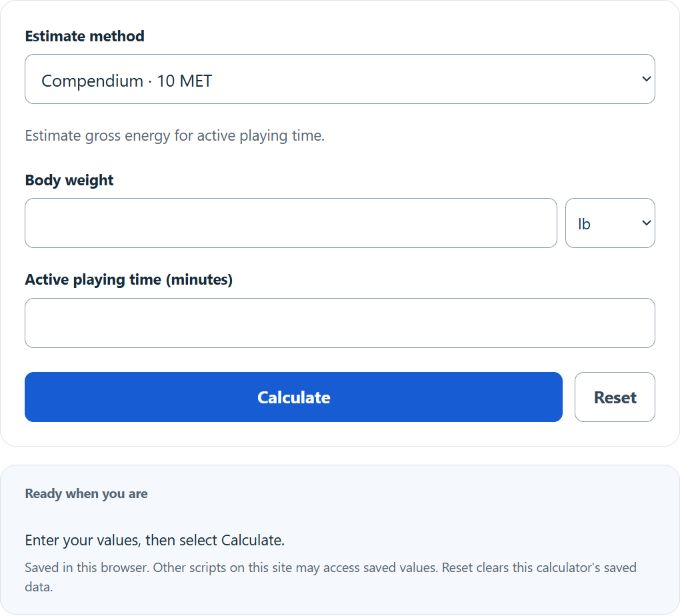
Estimate gross energy during active water polo play using body weight and minutes played. Choose the Compendium reference or explicitly labeled legacy pace assumptions.
- Swimming Calories Calculator
- Maintenance Calories Calculator
- Calorie Calculator
- Calories Per Hour Calculator
- Calories Burned Bootcamp Calculator
Water Polo Game Calories Burned Formula
The default uses the 2024 Adult Compendium water polo reference (code 18360, 10 MET) with C = weight in kg × minutes × 0.175 kcal/(kg·min). This oxygen-based estimate includes resting energy and is not an individual measurement. The separate legacy method retains the historical pace factors as unvalidated assumptions.
- C = calories burned
- W = body weight
- T = game duration in minutes
- F = calorie factor for the selected method (0.175 kcal per kilogram per minute for the default reference)
Legacy Water Polo Pace Assumptions
- Recreational assumption: 0.1167 kcal per kilogram per minute; not a validated pace category
- Typical assumption: 0.1333 kcal per kilogram per minute; not a validated pace category
- Competitive assumption: 0.1667 kcal per kilogram per minute; not a validated pace category
Typical Calories Burned in 60 Minutes of Water Polo
Using the default 10 MET reference for 60 active minutes, gross energy is approximately:
- 140 lb: 667 kcal
- 160 lb: 762 kcal
- 180 lb: 857 kcal
- 200 lb: 953 kcal
- 220 lb: 1,048 kcal
How to Calculate Calories Burned Playing Water Polo
For a 180-pound player with 60 active minutes using the default reference (180 lb = 81.6466266 kg):
If the same player instead selects the legacy Competitive assumption:
Water Polo and Calorie Burn
Water polo combines sprint swimming, constant eggbeater kicking, fast changes of direction, overhead throwing, and physical positioning around the goal. Enter active playing time rather than bench time or total event duration. The reference does not distinguish positions or match intensity; actual energy use varies.
- More minutes in the pool means a higher total calorie burn.
- Faster counterattacks and heavier defensive play push calories burned higher per minute.
- Centers, defenders, and players involved in frequent transitions often work at the highest pace.