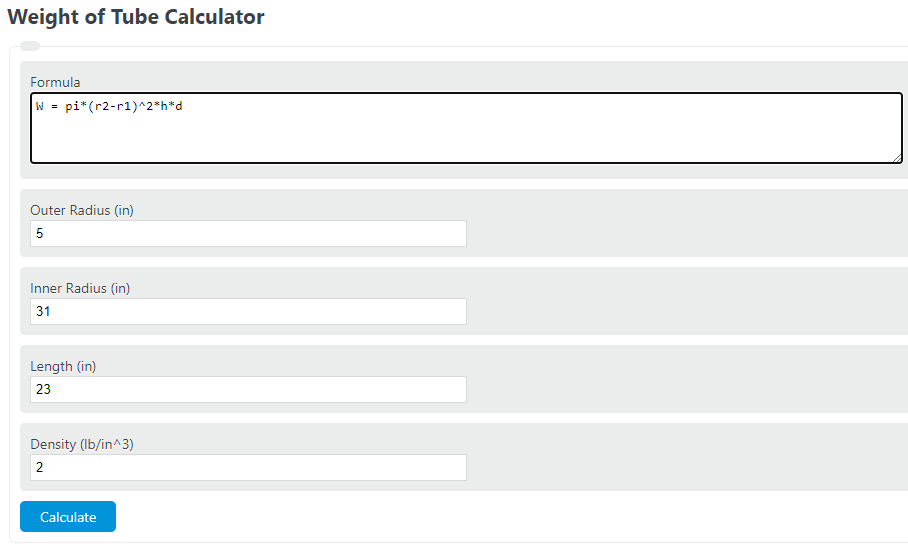
Weight of Tube Calculator finds hollow tube mass from OD, ID or wall thickness, length, material, and quantity, with kg, lb, mass-per-length, and fill load.
- Hollow Shaft Diameter Calculator
- Pipe Bend Weight Calculator
- Specific Gravity to Density Calculator
- Tube Bend Radius Calculator
- Pipe Volume Calculator
- Surface Area of a Pipe Calculator
- Cylinder Weight Calculator
- All Construction Calculators
Weight of Tube Formula
The weight of a tube is calculated from the volume of the tube wall multiplied by the material density. The calculator first converts the dimensions to centimeters, calculates the hollow-cylinder volume in cubic centimeters, then converts the result to pounds or kilograms.
- V = tube material volume, in cm³
- OD = outer diameter, converted to cm
- ID = inner diameter, converted to cm
- L = tube length, converted to cm
- rho = material density, converted to lb/cm³
- W_lb = tube weight in pounds
- W_kg = tube weight in kilograms
The outer diameter and inner diameter define the wall area of the tube. The calculator subtracts the hollow inner circle from the full outer circle, then multiplies by length to get volume. Density is then applied to convert that volume into weight. If you select kilograms, the calculated pound value is converted to kg at the end.
Common Tube Material Densities
Use a density that matches your material. The default value, 7.85 g/cm³, is typical for carbon steel.
| Material | Typical Density | Use in Calculator |
|---|---|---|
| Carbon steel | 7.85 g/cm³ | 7.85 with g/cm³ selected |
| Stainless steel | 7.90 to 8.00 g/cm³ | 7.9 or 8.0 with g/cm³ selected |
| Aluminum | 2.70 g/cm³ | 2.70 with g/cm³ selected |
| Copper | 8.96 g/cm³ | 8.96 with g/cm³ selected |
| Brass | 8.4 to 8.7 g/cm³ | 8.5 with g/cm³ selected for an estimate |
| PVC | 1.35 to 1.45 g/cm³ | 1.4 with g/cm³ selected for an estimate |
Unit Conversions Used for Tube Weight
| Input Type | Conversion |
|---|---|
| Inches to centimeters | 1 in = 2.54 cm |
| Meters to centimeters | 1 m = 100 cm |
| Grams per cm³ to pounds per cm³ | 1 g/cm³ = 0.00220462 lb/cm³ |
| Kilograms per m³ to pounds per cm³ | 1 kg/m³ = 0.00000220462 lb/cm³ |
| Pounds to kilograms | 1 lb = 0.45359237 kg |
Example Calculations
Example 1: Steel tube in centimeters
Find the weight of a steel tube with an outer diameter of 10 cm, an inner diameter of 8 cm, a length of 100 cm, and a density of 7.85 g/cm³.
- Outer radius = 10 / 2 = 5 cm
- Inner radius = 8 / 2 = 4 cm
- Volume = pi * (5² – 4²) * 100
- Volume = pi * 9 * 100 = 2827.4334 cm³
- Density = 7.85 g/cm³ = 0.0173063 lb/cm³
- Weight = 2827.4334 * 0.0173063 = 48.9230 lb
Example 2: Aluminum tube in inches
Find the weight of an aluminum tube with an outer diameter of 2 in, an inner diameter of 1.5 in, a length of 36 in, and a density of 2.70 g/cm³.
- Outer diameter = 2 * 2.54 = 5.08 cm
- Inner diameter = 1.5 * 2.54 = 3.81 cm
- Length = 36 * 2.54 = 91.44 cm
- Volume = pi * (2.54² – 1.905²) * 91.44 = 810.7912 cm³
- Density = 2.70 g/cm³ = 0.0059525 lb/cm³
- Weight = 810.7912 * 0.0059525 = 4.8261 lb
FAQ
Is tube weight calculated from outer diameter or wall thickness?
This calculator uses outer diameter and inner diameter. Wall thickness is already included indirectly because the difference between the outer and inner diameters defines the tube wall. If you only know wall thickness, calculate the inner diameter first:
where t is the wall thickness.
Why must the inner diameter be smaller than the outer diameter?
The inner diameter represents the hollow opening inside the tube. If it is equal to or larger than the outer diameter, there is no valid tube wall to calculate. After unit conversion, the inner diameter must be less than the outer diameter.
Does the result include coatings, threads, welds, or end fittings?
No. The result is based only on a straight hollow tube with a constant outer diameter, inner diameter, length, and density. Coatings, threads, weld seams, caps, flanges, and fittings can add extra weight and should be added separately if they matter for your estimate.