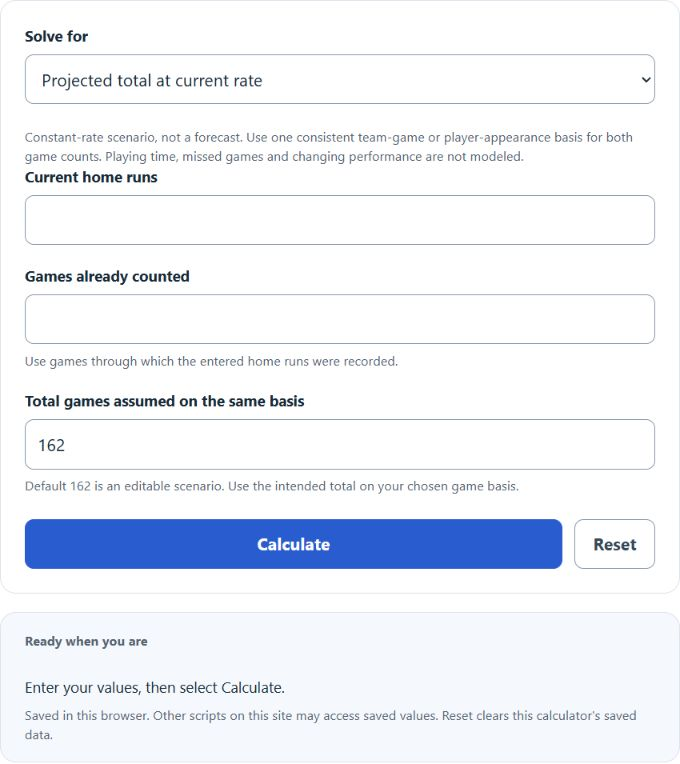
Calculate a constant-rate home-run projection or the average rate needed for a target. Keep the current and assumed total game counts on the same team-game or player-appearance basis; the result is a scenario rather than a forecast.
Related Calculators
- Playing Time Calculator
- Football Win Probability Calculator
- Rebound Ratio Calculator
- Golf Slope Calculator
- All Sports and Fitness Calculators
Home Run Pace Formula
The following formula is used to calculate the home run pace for a given season.
Variables:
- P is the home run pace
- HR is the total home runs
- GP is the games played
- TG is the total games in the season
To calculate the home run pace, divide the total home runs by the games played. Multiply the result by the total games in the season to get the home run pace.
What is Home Run Pace?
Home run pace extrapolates an observed rate to an assumed total number of games. It does not estimate uncertainty or account for changes in playing time or performance. If GP means player appearances, TG must be the assumed total player appearances; if using team games elapsed, TG must use that same basis. The default 162 is editable. For a target, additional HR = max(target − current HR, 0) and required rate = additional HR/(TG − GP). With no games left, a missing target has no defined future rate; an already reached target needs no further home runs.
How to Calculate Home Run Pace?
The following steps outline how to calculate the Home Run Pace.
- First, determine the total number of home runs (HR).
- Next, determine the number of games played (GP).
- Next, determine the total number of games in the season (TG).
- Finally, calculate the home run pace using the formula P = (HR / GP) * TG.
- After inserting the values and calculating the result, check your answer with the calculator above.
Example Problem :
Use the following variables as an example problem to test your knowledge.
Total Home Runs (HR) = 20
Games Played (GP) = 50
Total Games in Season (TG) = 162. Projection = (20/50) × 162 = 64.8 HR, or 65 as a nearest-whole comparison. This assumes an unchanged rate on the same game-count basis.