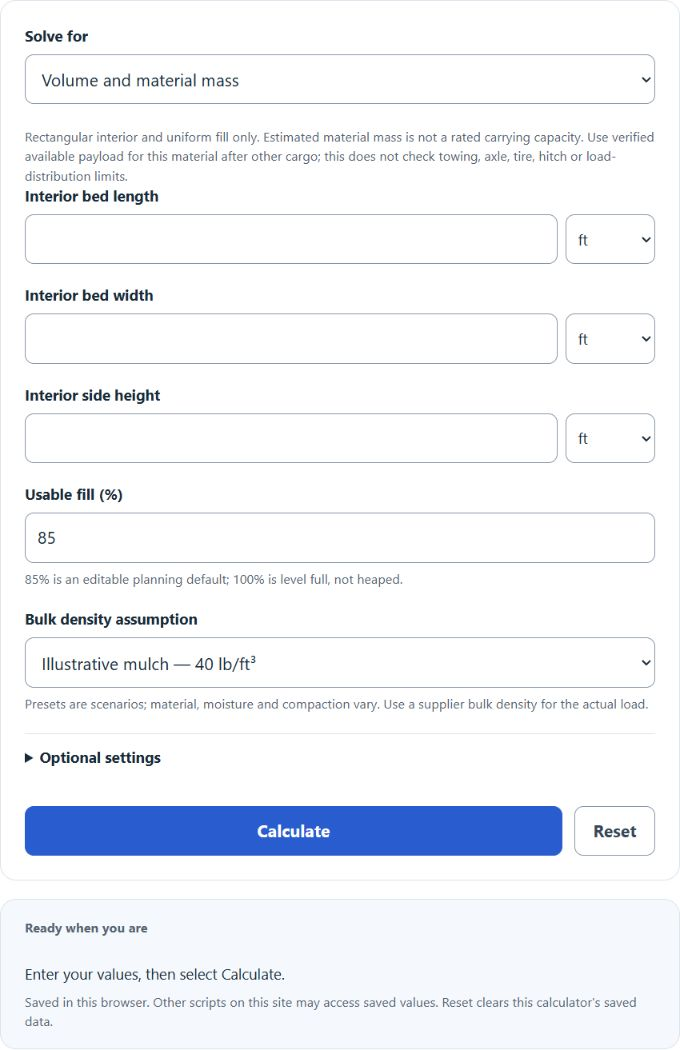
Estimate rectangular bed volume and material mass from dimensions, fill percentage and bulk density, or derive uniform depth from available material payload. Includes cubic yards, US short tons and optional payload/height comparisons.
- All Construction Calculators
- Trailer Load Capacity Calculator
- Trailer Offtracking Calculator
- Bulk Density Calculator
- Load Density Calculator
- Soil Stockpile Volume Calculator
- Box Volume Calculator
- Yards to Tons Calculator
Dump Trailer Capacity Formula
The following equation is used to calculate the Dump Trailer Capacity based on volume.
- Where V is the trailer volume (ft³)
- L is the length (ft)
- W is the width (ft)
- H is the height (ft)
Multiply interior length, width and side height to find rectangular volume, then multiply by fill percentage/100. Divide ft³ by 27 for yd³. Volume times bulk density gives estimated material mass, not the trailer’s rated payload. One US short ton is 2,000 lb. Density presets are illustrative assumptions; use the actual supplier’s bulk density.
What is a Dump Trailer Capacity?
Definition:
Geometric capacity and rated payload are different limits. This calculator estimates a uniform rectangular load; it does not certify safe loading or towing. Use the net cargo allowance remaining for this material after trailer tare/options and other cargo, then independently check manufacturer, axle, tire, hitch, tow-vehicle and load-distribution limits. In depth mode, blank side height gives a payload-only depth; entering a height cap takes the lesser of that cap and the payload-derived depth. Big Tex dump-trailer owner’s manual distinguishes cargo allowance from GVWR.
How to Calculate Dump Trailer Capacity?
Example Problem:
The following example outlines the steps and information needed to calculate the dump trailer capacity.
First, determine the trailer dimensions. In this example, the rectangular interior is 10 ft long, 6 ft wide and 2 ft high, with 100% level fill (change the editable 85% planning default).
Next, calculate volume: V = L × W × H = 10 × 6 × 2 = 120 ft³.
To convert this to cubic yards, divide by 27: 120 ft³ ÷ 27 ≈ 4.44 yd³.
If the material density is 100 lb/ft³, the estimated material mass would be 120 ft³ × 100 lb/ft³ = 12,000 lb (6 US short tons). This is not a claim that the trailer is rated to carry that mass.
FAQ
What factors can affect dump trailer capacity?
The primary factors include trailer dimensions (length, width, height), the density of the load material, and the trailer’s build specifications (axle ratings, frame strength, etc.). Overloading a trailer risks structural damage and compromises safety.
How can I prevent overloading my dump trailer?
Always consult the trailer’s rated load limit provided by the manufacturer, calculate the volume in cubic feet or yards, then factor in the load’s density. Staying within these guidelines helps protect both the trailer and its operator.
Can different materials drastically affect load weight despite similar volumes?
Yes. Different materials have widely varying densities. For instance, dry mulch may weigh significantly less than gravel or sand for the same volume. Always verify the density of each material before loading.
Does the shape of the trailer interior matter for capacity calculations?
Most calculations assume a rectangular trailer bed. If your trailer has angled or curved walls, you may need to approximate or measure the volume more carefully. Some manufacturers provide recommended load volumes for non-rectangular designs.